Moving to Palm Beach County means trading state income tax for a property tax bill, winters in the 70s for long, humid summers, and a big county for a choice of very different towns. The county has about 1.58 million people and 39 cities, towns and villages, from beach towns and golf communities to equestrian Wellington.
This guide covers what newcomers ask first: taxes, getting around, weather and hurricanes, insurance, schools, home prices, and how the towns in the north and center of the county compare. Each section ends with what to do next, and the town guides go deeper on any place that catches your eye.
Key takeaways
- Palm Beach County had an estimated 1,575,726 residents in July 2025, spread across 39 municipalities and large unincorporated areas. West Palm Beach is the county seat.
- Florida has no personal income tax. Your main local tax is property tax, which a homestead exemption can lower if the home is your permanent residence.
- I-95, Florida’s Turnpike, Brightline, Tri-Rail and President Donald J. Trump International Airport (DJT, formerly PBI) connect the county with the rest of South Florida and beyond.
- The median single-family home sold for $656,000 and the median townhouse or condo for $310,000 in September 2026, according to Florida Realtors data.
- Plan your insurance, flood risk check and school choice early, because each has its own calendar.
What is Palm Beach County like at a glance?
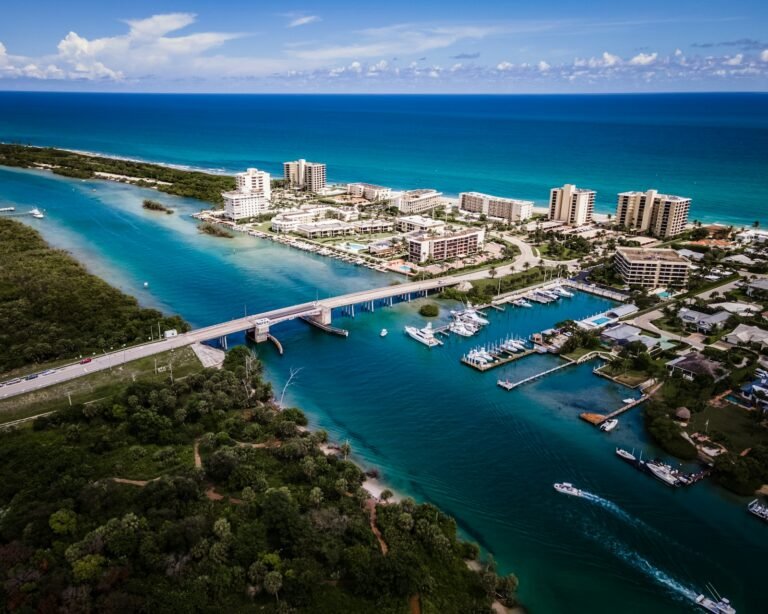
Palm Beach County is a large, fast-growing county on Florida’s southeast coast, between Martin County to the north and Broward County to the south. The U.S. Census Bureau estimated 1,575,726 residents on July 1, 2025, up from 1,492,191 in the 2020 census. West Palm Beach is the county seat, and the county has 39 incorporated municipalities.
The county is wide as well as long. It covers about 1,964 square miles of land, according to the 2020 census, and the county Tax Collector describes it as one of the largest counties east of the Mississippi River. That size matters when you choose where to live, because the coast, the western suburbs and the farmland around Lake Okeechobee feel like different places.
A simple way to picture it:
- The coast and the Intracoastal. Beach towns, island condos and older neighborhoods close to the water, from Lake Worth Beach up through Singer Island, Juno Beach, Jupiter and Tequesta.
- The I-95 and US-1 corridor. Downtown West Palm Beach, Riviera Beach, North Palm Beach and Palm Beach Gardens, with most of the jobs, shopping and hospitals.
- The western suburbs. Planned communities and larger lots, with Wellington best known for its winter equestrian season.
Most people who move here for work or family end up choosing between those three bands first, then a town, then a neighborhood.
Does Palm Beach County have a state income tax?
Palm Beach County residents pay no state personal income tax, because Florida does not have one. The Florida Department of Revenue states that Florida does not impose personal income tax, inheritance tax or gift tax. Your main local tax as a homeowner is property tax, plus sales tax on most purchases.
Property tax is where the real planning happens. Each home is taxed on its assessed value at a combined rate set by the county, the school district, the city or town and other taxing districts. Rates differ from one town to the next, so two homes with the same price can carry different tax bills.
If the home will be your permanent residence, apply for the homestead exemption with the Palm Beach County Property Appraiser by March 1 of the year after you own and live in it. It lowers the taxable value and caps how fast your assessment can rise. Our homestead exemption guide walks through who qualifies, how to file and what a buyer’s first tax bill looks like.
Budget tip for buyers
Do not budget from the seller’s current tax bill. In Florida the assessed value usually resets to market value after a sale, so the new owner’s bill can be higher than the one in the listing. Ask your agent for an estimate based on your purchase price.
Starting your search? See homes for sale across Palm Beach County and save the ones you like.
How do you get around Palm Beach County?
Getting around Palm Beach County mostly means driving on I-95, Florida’s Turnpike and US-1, with rail as a strong backup for trips south. Brightline stops in West Palm Beach and Boca Raton, Tri-Rail has six stations in the county, and President Donald J. Trump International Airport sits about three miles from downtown West Palm Beach.
Highways
I-95 runs north and south near the coast and is the main commuter route. Florida’s Turnpike runs parallel to the west and is often the faster choice for long trips toward Orlando or Miami. US-1 and A1A are the slower, local roads along the coast and the Intracoastal Waterway. East and west roads such as Okeechobee Boulevard, Northlake Boulevard, PGA Boulevard and Indiantown Road link the coast with the western suburbs.
Trains
Brightline, the higher-speed intercity train, serves Palm Beach County at two stations: West Palm Beach and Boca Raton. From there it runs south to Fort Lauderdale, Aventura and Miami and north to Orlando.
Tri-Rail, the commuter train, has six stations in the county: Mangonia Park, West Palm Beach, Lake Worth Beach, Boynton Beach, Delray Beach and Boca Raton. It runs south through Broward County to Miami-Dade, so it suits commuters who work further south.
The airport
Palm Beach International Airport was renamed President Donald J. Trump International Airport on July 9, 2026. Its three-letter code changed from PBI to DJT on August 18, 2026, so use DJT when you book. The airport is in West Palm Beach, about three miles from downtown, and served 13 airlines with more than 35 nonstop destinations according to its October 2025 fact sheet.
What is the weather like, and when is hurricane season?
Palm Beach County weather is warm all year, with mild, dry winters and hot, humid, rainy summers. At the airport weather station, the 1991 to 2020 normal high is 75°F and low 58°F in mid-January, and 90°F and 77°F in early August. The Atlantic hurricane season runs from June 1 to November 30.
Winter, roughly December through April, is high season. Roads, restaurants and golf courses are busier, and many seasonal residents arrive. Summer brings afternoon thunderstorms, high humidity and the peak of the tropical season, which is also when the beaches and roads are quietest.
Hurricane season shapes home buying more than newcomers expect. It affects:
- Insurance timing. When a named storm threatens, insurers can stop writing new policies for a time, so get quotes early in your contract.
- Home features. Impact windows, shutters, roof age and roof-to-wall connections all affect what you pay for wind coverage.
- Flood risk. Low-lying streets near the coast and the Intracoastal can flood in heavy rain or storm surge.
Before you make an offer, read our guides to flood zones and flood insurance and to 4-point and wind mitigation inspections. Both explain what to check during your inspection period.
What should you know about home insurance before you move?
Home insurance in Palm Beach County is one of the biggest monthly costs after the mortgage, and it depends on the home’s age, roof, windows, flood zone and distance from the coast. The market has been improving: Florida’s Office of Insurance Regulation said in May 2026 that 20 new insurers had entered since the state’s reforms.
The same May 2026 announcement reported that the average homeowners rate request over the previous 180 days was down 2.9%, compared with an increase of 0.7% a year earlier. That is good news, but it is an average. Your own quote will depend on the specific house.
Practical steps for newcomers:
- Get a quote before you are under contract, if you can. An insurance agent can give a rough figure from the address, year built and roof type.
- Order inspections early. Older homes usually need a 4-point inspection, and a wind mitigation report can lower the wind part of the premium.
- Check flood separately. Standard homeowners policies do not cover flood. Look up the flood zone and ask for a flood quote even if the lender does not require it.
- Ask about condo coverage. In a condo, the association insures the building and you insure the inside of your unit. Our condo buying guide covers what else to review.
Always confirm coverage and price with a licensed insurance agent. Your agent can share inspection reports and seller disclosures so the quote is accurate.
How do public schools work in Palm Beach County?
Public schools in Palm Beach County are run by a single countywide district, the School District of Palm Beach County. It serves more than 193,000 students and calls itself the 10th largest school district in the country. Your address sets your zoned schools, and choice programs let families apply to schools beyond their zone.
Choice programs, also called magnet or career academies, cover subjects such as the arts, engineering, medicine, business and the environment. Families apply during a set window, and seats are filled by lottery.
The calendar runs early. For the 2026 to 2027 school year, the on-time deadline was December 5, 2025 for a group of arts and selected programs and January 30, 2026 for all other choice programs, with assignments shared on April 2, 2026. A late window then ran from March 30 to May 1, 2026. Dates change each year, so check the district’s school choice page in the fall before the year you need.
Check zoning by address
School boundaries do not always follow town lines. Before you make an offer, look up the exact address with the school district’s boundary tool. A listing that says “Jupiter schools” or “Gardens schools” is a starting point, not a promise.
How much do homes cost in Palm Beach County?
Home prices in Palm Beach County depend heavily on the type of home and the town. In September 2026, the countywide median sale price was $656,000 for single-family homes, up 6.7% from a year earlier, and $310,000 for townhouses and condos, up 3.3%, according to Florida Realtors data released October 16, 2026.
| Palm Beach County, September 2026 | Single-family homes | Townhouses and condos |
|---|---|---|
| Median sale price | $656,000 | $310,000 |
| Change from September 2025 | Up 6.7% | Up 3.3% |
| Closed sales | 1,132 | 782 |
A median is the middle sale, so half of homes sold for more and half for less. Waterfront homes, newer gated communities and the island markets sit well above the county median, while older condos and inland neighborhoods often sit below it.
Your total monthly cost includes more than the mortgage. Add property tax, homeowners insurance, flood insurance if you need it, and any HOA or condo fees. Buyers also pay closing costs. Our closing costs guide shows who pays what in Palm Beach County, with a worked example.
For a current snapshot of a town, see the market reports page or ask for a short list of recent sales in the neighborhoods you like.
Which Palm Beach County town fits you?
Choosing a Palm Beach County town comes down to how close you want to be to the beach, how long a commute you will accept, the type of home you want and your budget. The towns below run from Lake Worth Beach in the center of the county up to Tequesta at the northern edge, plus Wellington in the west.
| Town | What it is like | Typical homes | Often a fit for |
|---|---|---|---|
| Lake Worth Beach | Artsy coastal city with a walkable downtown, a public beach and pier, and a Tri-Rail station | Older single-family homes, cottages, condos | Buyers who want character and walkability |
| West Palm Beach | The county seat, with Clematis Street, the Norton Museum of Art, the Kravis Center and historic districts | Downtown condos, 1920s homes, suburbs | Commuters, city lovers, rail users |
| Riviera Beach | Port city of about 39,000 people with a marina and water taxis to Peanut Island | Mainland homes and townhomes, lagoon waterfront | Boaters and value seekers near the water |
| Singer Island | Ocean island with high-rise condos and MacArthur Beach State Park at the north end | Oceanfront condos, mid-century homes in Palm Beach Shores | Beach lovers, seasonal residents |
| North Palm Beach | Waterfront village from 1956, ringed by the Intracoastal, with a public Jack Nicklaus Signature course | Waterfront and canal homes, condos | Boaters, golfers, quiet village life |
| Palm Beach Gardens | Golf and shopping hub with PGA National, The Gardens Mall and Downtown at the Gardens | Gated golf communities, single-family homes | Families, golfers, I-95 and Turnpike commuters |
| Juno Beach | Small beach town of about 3,900 people with a 990-foot pier and a major sea turtle nesting beach | Ocean and Intracoastal condos, some single-family streets | Retirees, part-year residents, beach walkers |
| Jupiter | Town near the north end of the county, with the Jupiter Inlet Lighthouse, beaches and spring training baseball | Everything from condos to waterfront estates | Families and outdoor and boating fans |
| Tequesta | Quiet riverside village of about 6,000 people on the Loxahatchee River | Established single-family streets, riverfront homes | Buyers who want small-village calm |
| Wellington | Family-focused village in the west, home of the Winter Equestrian Festival | Family neighborhoods, equestrian properties | Families and horse owners |
If you want the beach close by
Singer Island, Juno Beach, Jupiter and Lake Worth Beach put you closest to the sand. Singer Island and Juno Beach are mostly condo markets, while Jupiter and Lake Worth Beach mix condos with single-family homes. Tequesta residents use Coral Cove Park and Blowing Rocks Preserve on Jupiter Island, a short drive over the Intracoastal Waterway.
If you want space and a yard
Palm Beach Gardens and Wellington offer the most planned communities with single-family homes, many with community pools, golf or clubhouses. Jupiter also has large neighborhoods west of US-1, such as Abacoa. Expect HOA rules and fees in many of these communities.
If you want a city feel
West Palm Beach is the only true downtown in the area, with Brightline, Tri-Rail, a trolley, theaters and restaurants. Lake Worth Beach has a smaller, more casual downtown with galleries and independent shops on Lake Avenue and Lucerne Avenue.
If you want to be on the water
North Palm Beach, Riviera Beach, Jupiter and Tequesta have many homes on canals, the Intracoastal or the Loxahatchee River. Ask about dock rights, bridge heights to open water, seawall condition and flood zones before you fall for a view.
Still deciding between the two biggest north county towns? Our Jupiter vs Palm Beach Gardens comparison puts them side by side. You can also browse all neighborhood guides.
Not sure where to start? Tell Shakir your budget, commute and must-haves, and he will suggest two or three towns to tour.
What should be on your moving checklist?
A Palm Beach County moving checklist should cover the home purchase, insurance, utilities, Florida paperwork and the property tax exemption. The steps below follow the order most buyers need them, from the first search to the first January in your new home. Confirm deadlines and documents with each agency, because rules can change.
- Pick two or three towns. Visit at rush hour and on a weekend, and drive the commute you will really make.
- Get pre-approved. A lender letter shows sellers you are ready and tells you your real budget, including taxes and insurance.
- Check the flood zone and insurance before you offer. Ask for the seller’s disclosures, any elevation certificate and the roof age.
- Use your inspection period well. Book the general inspection, 4-point and wind mitigation reports, and any condo document review in the first days.
- Look up schools by address. Note any choice program deadlines if you have children.
- Set up utilities. Ask the seller or your agent which electric, water and trash providers serve the address, since they differ by town.
- Update your Florida paperwork. Visit the Palm Beach County Tax Collector to get a Florida driver license and register your vehicle, and update your voter registration with the Supervisor of Elections. Check each office’s current rules and timelines.
- File for homestead by March 1. If the home is your permanent residence as of January 1, file with the Property Appraiser by March 1. The Florida driver license and vehicle registration help prove residency.
- Prepare for hurricane season. Before June 1, learn your evacuation zone, test shutters and keep copies of your insurance policies.
How do you buy a home in Palm Beach County from out of state?
Buying a home in Palm Beach County from out of state works much like a local purchase, with more done by video, email and electronic signatures. Most buyers take one or two scouting trips, then tour finalists in person or live on video, sign electronically and close with a title company that can handle remote or mail-away closings.
Tips that help:
- Plan a scouting trip in the right season. A winter visit shows the area at its busiest. A summer visit shows the heat, rain and quieter roads.
- Use saved searches. Save homes on the Search Homes page and set up email alerts so you see new listings quickly.
- Ask for live video tours. A video walk-through shows street noise, smells, light and water views that photos can miss.
- Line up local help early. A Florida lender, an inspector, an insurance agent and a title company who know the area keep the timeline on track.
- Learn the local steps. Our buyer’s guide explains the Palm Beach County process from offer to keys.
Frequently asked questions
Is Palm Beach County a good place to live?
Palm Beach County suits many people who want warm weather, beaches, no state income tax and a choice of town styles. The tradeoffs are higher home prices than much of Florida, rising insurance costs, summer heat and hurricane risk. Visiting in both winter and summer is the best way to judge it.
How many cities and towns are in Palm Beach County?
Palm Beach County has 39 incorporated municipalities, according to the county government. They range from West Palm Beach, the county seat, to small towns such as Juno Beach and Palm Beach Shores. Large areas of the county are unincorporated, so a home’s mailing city may differ from the government that serves it.
What is the airport in Palm Beach County called now?
The county’s main airport is President Donald J. Trump International Airport. It was known as Palm Beach International Airport until the new name took effect on July 9, 2026. Its passenger code changed from PBI to DJT on August 18, 2026. The airport sits about three miles from downtown West Palm Beach.
Does Palm Beach County have a train to Miami?
Palm Beach County has two train options to Miami. Brightline runs from stations in West Palm Beach and Boca Raton to Fort Lauderdale, Aventura and Miami, and also north to Orlando. Tri-Rail, the commuter rail line, stops at six Palm Beach County stations from Mangonia Park to Boca Raton and continues to Miami-Dade County.
When should I file for the homestead exemption after moving?
File for the homestead exemption with the Palm Beach County Property Appraiser by March 1 of the year after you own the home and make it your permanent residence. Eligibility is based on your status on January 1. For example, if you buy and move in during October 2026, you would file by March 1, 2027.
Sources
- U.S. Census Bureau, QuickFacts: Palm Beach County, Florida
- Palm Beach County, Municipalities
- Palm Beach County Tax Collector, Welcome Guide for New Residents
- Florida Department of Revenue, Tax Information for New Residents
- Brightline, station list (press room)
- Tri-Rail, Palm Beach County destinations and stations
- President Donald J. Trump International Airport, Name Change FAQs
- Palm Beach International Airport fact sheet, October 2025
- National Weather Service Miami, Daily Normals 1991 to 2020, West Palm Beach
- NOAA, 2026 Atlantic hurricane season outlook
- Florida Office of Insurance Regulation, new property and casualty insurers, May 20, 2026
- School District of Palm Beach County, Superintendent
- School District of Palm Beach County, Choice application deadlines 2026 to 2027
- School District of Palm Beach County, School Choice overview
- Florida Realtors, Palm Beach County single-family homes, September 2026
- Florida Realtors, Palm Beach County townhouses and condos, September 2026
This article is general information, not legal, tax or insurance advice. Rules, rates and deadlines change, so confirm the details with the official source, a Florida real estate attorney, your title company, your insurance agent or a tax professional before you rely on them.

With over 10 years of experience as a successful real estate agent, I have proudly helped hundreds of happy buyers and sellers achieve their real estate goals. I’m passionate about helping clients find their dream homes, sell their properties with confidence, and navigate every step of the process with ease. My commitment to personalized service, strong relationships, and exceptional results makes every real estate journey a rewarding experience.
REALTOR® with Continental Properties, Inc. in North Palm Beach. Florida license #3346934.